Some children have no interest in cooking dinner but will happily spend two hours making cupcakes.
That is not a contradiction, and it is worth understanding if you are trying to get a child into the kitchen. Baking is a different activity from cooking, and it appeals to a different kind of kid. Cooking rewards improvisation, tasting, and adjusting as you go. Baking rewards precision, patience, and following a sequence exactly. It is chemistry with a delicious result, and it ends in something a child can hold up and be genuinely proud of.
For a lot of children, baking is the door into the kitchen that cooking never was.
At CocinarTe in Hillsboro, we teach both, and we have watched plenty of children discover they are bakers rather than cooks. This guide covers what children actually learn in a baking class, what to expect at each age, how to tell a good class from a mediocre one, and what our baking classes and camps look like.
What Kids Actually Learn in a Baking Class
A good baking class is not a demonstration with a taste at the end. Children should be measuring, mixing, kneading, and decorating with their own hands from the first ten minutes. Here is what those hands are actually building.
- Measuring and leveling, age 5 and up. Fractions, ratios, and precision in a context where the answer matters.
- Following a sequence, age 5 and up. Reading for a purpose, and the discipline of not skipping ahead.
- Mixing and folding, age 3 and up. Hand strength and control, plus the patience to stop before overmixing.
- Kneading and shaping, age 6 and up. Full body work, tactile feedback, and learning what ready feels like.
- Timing and waiting, age 6 and up. Delayed reward, which is genuinely hard and genuinely teachable.
- Decorating, age 3 and up. Fine motor control, planning, and creative ownership of the result.
- Oven and heat safety, age 7 and up. Real risk, handled with real responsibility.
- Cleaning as you go, age 5 and up. The least glamorous and most useful habit in any kitchen.
The thing parents most often underestimate is the maths. A child who has halved a recipe, tripled a batch, or worked out that they need three quarter cups because the half cup is dirty has done more useful fraction work in twenty minutes than a worksheet delivers in a week. It sticks because the cake fails if they get it wrong.
Baking by Age: What to Expect
Age matters more in baking than in most children's activities, because ovens and mixers are involved. A well run programme groups children tightly by age rather than lumping a five year old in with an eleven year old.
Ages 3 to 6: Baking With a Grown Up
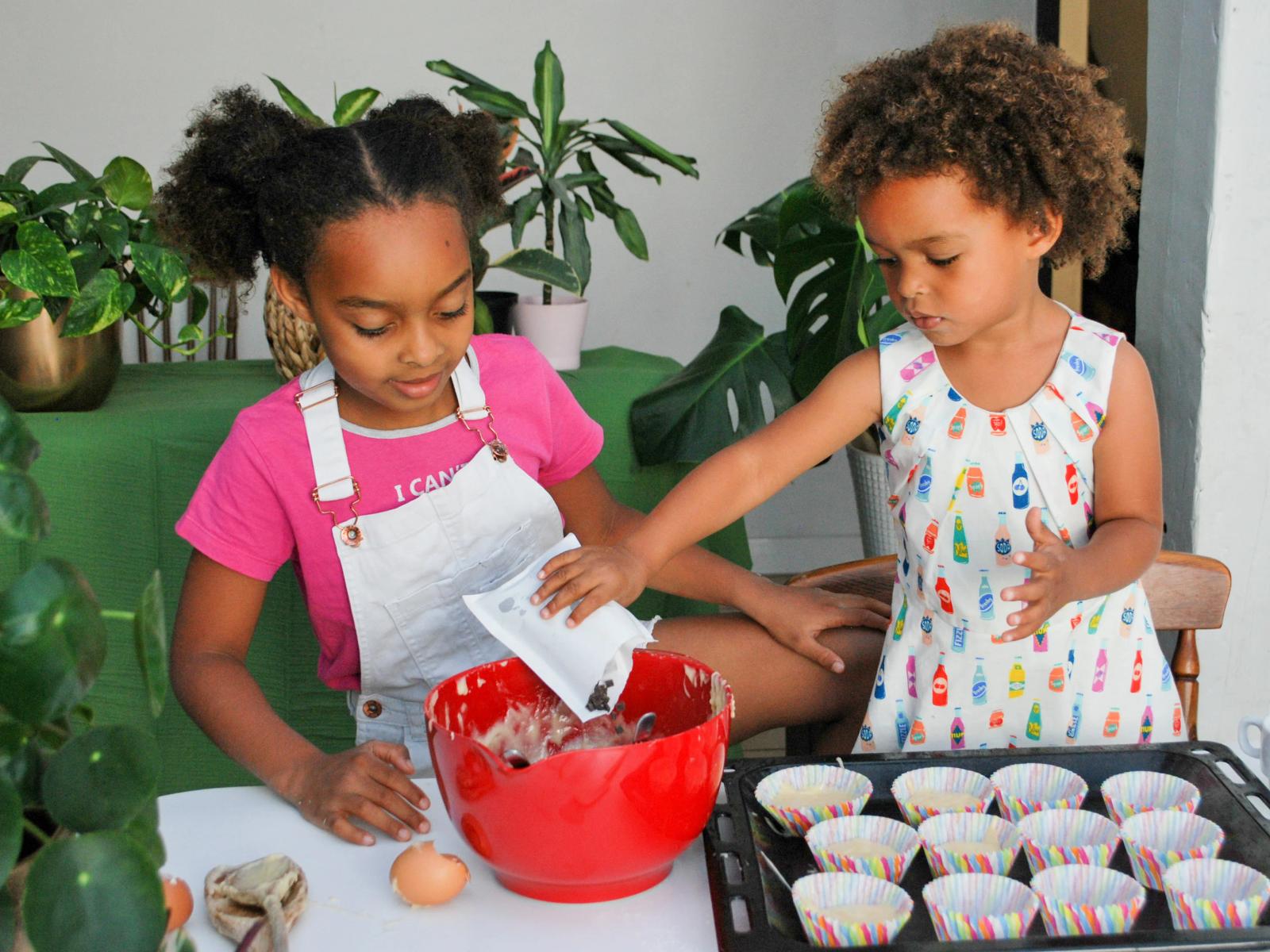
At this age the child is a genuine participant, not an observer, but an adult should be alongside them. The work is pouring, stirring, mashing, sprinkling, and decorating. No oven handling, and no sharp tools beyond a butter knife.
Expect short attention spans and enormous pride. A three year old who sprinkled the sugar believes, correctly, that they made the whole thing.
This is what our Chefcitos Together classes are built for, ages 3 and up with a parent or caregiver in the room working alongside their child.
Ages 7 to 12: Independent Baking
This is the sweet spot for baking. Children in this range can read a recipe, measure accurately, understand why the order of steps matters, and handle real equipment with supervision. They can also work as a team, which changes the whole feel of a class.
They are old enough to be trusted with a hot tray and a mixer, and young enough to be delighted by the result. They can genuinely own a recipe from start to finish.
Our Mini Chefcitos classes serve ages 7 to 12 as kids only sessions, without parents in the room. That matters more than it sounds, and we will come back to it.
Teens
Teenagers can bake at essentially an adult level, and they generally want to be treated that way. The interesting work at this age is technique rather than novelty: laminated dough, bread, tempering chocolate, understanding why a recipe works so they can change it.
Our Cocina Creativa workshops run for teens and adults at beginner, intermediate, and advanced levels.
Baking or Cooking Classes: Which Should You Start With?
Parents ask us this constantly, and the honest answer is that it depends on your child's temperament more than their age.
Start with baking if your child...
- Likes rules, instructions, and getting things exactly right
- Enjoys measuring, sorting, and precision
- Wants a clear, impressive finished product
- Is motivated by sweets, which is not a character flaw
- Has been reluctant about cooking, because baking often works where cooking did not
Start with cooking if your child...
- Prefers to improvise and taste as they go
- Is a picky eater you are trying to broaden
- Likes savoury food more than sweet
- Gets frustrated by precision and rules
- Wants skills they can use for actual meals at home
Plenty of children end up doing both. But if one has already failed to take hold, switching to the other is a better move than trying harder with the same one.
What to Look for in a Kids Baking Class
Not all classes are equal, and the differences are easy to spot once you know what to ask about.
- Every child working, not watching. This is the single biggest difference between a real class and an expensive demonstration. Ask how many children share a station and how many share a bowl. If the answer is vague, that is an answer.
- A tight age range. A group spanning ages 5 to 12 will bore the older children and overwhelm the younger ones. Look for narrow bands.
- Real tools and real ovens. Children learn heat safety by handling heat with supervision, not by being kept away from it. A class where an adult does all the oven work has removed a genuine part of the skill.
- Small groups. Baking involves timing, hot equipment, and a lot of simultaneous steps. It does not scale to a big room.
- Clear allergy handling. Baking means flour, eggs, dairy, and often nuts. Ask directly how allergies are managed, what substitutions are available, and whether the kitchen can accommodate your child. A good programme will answer specifically.
- Something to take home. The finished item is not a bonus, it is the point. Children who carry their own bread or cupcakes out of the door understand that they made something real.
- Cleaning included. A class that cleans up for the children has skipped half the lesson.
Questions to Ask Before You Book
- How many children are in the class, and how many adults?
- What is the age range in the room?
- Will my child do every step themselves, or watch some of them?
- How do you handle allergies and dietary restrictions?
- Do children use the oven, and how is that supervised?
- What will my child bring home?
- Do parents stay or drop off?
- What should my child wear, and do you provide aprons?
Baking Classes and Camps at CocinarTe
We are a hands on cooking and baking studio in Hillsboro, Oregon, at 770 NE Rogahn Street, and we teach children from age 3 through teens and adults. Our angle is Latin flavors, so alongside the cookies and cupcakes you will find pan dulce, empanadas, tres leches, and conchas.
Our class formats
- Chefcitos Together, ages 3 and up, with a parent or caregiver
- Mini Chefcitos, ages 7 to 12, kids only
- Cocina Creativa, teens and adults, beginner through advanced
Sessions run 1.5 to 2 hours. Classes are typically $60 to $80 per child, and family classes run $120 to $150 per family. Cooking and baking birthday parties start at $450.
Our baking camps
We also run baking focused school break camps under the name Bake and Create. The format is a week of half days, roughly 9:00am to 12:30pm, for ages 7 and up, building real skills across five consecutive mornings rather than a single one off session. Children work through measuring, mixing, shaping, and decorating, and the week finishes with a Mini Bakery Showcase where families come in to taste everything the kids have made.
That last part is not a marketing flourish. Presenting your own work to an audience is a genuinely different experience from taking a box home, and it is the thing campers talk about afterwards.
Why kids only classes work
Our ages 7 to 12 classes are drop off, and parents sometimes ask why. The answer is that children take more risks, ask more questions, and make more mistakes when a parent is not watching. A child who would not attempt something in front of their mother will absolutely attempt it in front of a chef and four peers. It is one of the more reliable patterns we see.
Frequently Asked Questions
At what age can kids start baking classes?
Children can start baking as young as 3 with an adult alongside them, doing the pouring, stirring, and decorating. Independent classes without a parent in the room generally start around age 7, when children can read a recipe, measure accurately, and handle equipment safely with supervision. At CocinarTe, Chefcitos Together classes start at age 3 and our kids only Mini Chefcitos classes run for ages 7 to 12.
What do kids learn in a baking class?
Far more than a recipe. Baking builds measuring and fraction skills, reading and following a sequence, hand strength and fine motor control, patience and delayed reward, heat and equipment safety, and the habit of cleaning as you go. Children also learn that precision matters, because a mismeasured bake genuinely fails, which is a lesson worksheets cannot deliver.
How much do kids baking classes cost?
It varies by format and length. Single sessions commonly run $50 to $90 per child, family classes more, and multi day camps are priced per day. At CocinarTe classes are typically $60 to $80 per child for a 1.5 to 2 hour session, family classes are $120 to $150 per family, and our school break baking camps run $120 per child per day. Always check what is included, particularly ingredients and whether the child takes their bake home.
Are baking classes good for kids?
Yes, and often for children who have resisted cooking. Baking suits children who like rules, precision, and a clear finished result, and it builds maths, reading, motor skills, and patience at the same time. It also tends to produce a confidence jump, because the outcome is visible, shareable, and unmistakably theirs.
Come and Bake With Us
If your child is the kind who wants to measure everything exactly and then decorate it badly on purpose, they will fit right in.
CocinarTe is at 770 NE Rogahn Street in Hillsboro, Oregon. Have a look at our current class and camp schedule, book a birthday party, or get in touch and tell us your child's age and what they are into. We will point you at the right session, including if that turns out to be a cooking class rather than a baking one.
CocinarTe PDX
Kids Cooking School • Hillsboro, Oregon
CocinarTe is a kids cooking school and family experience studio in Hillsboro, Oregon. Through hands-on classes, birthday parties, and cultural cooking experiences rooted in Latin American cuisine, CocinarTe teaches children and families that the kitchen is the best classroom in the house.